

No. Structural scoliosis is not something chiropractic care cures or permanently straightens. Chiropractic care may help improve mobility, muscle function, posture control, comfort, and daily movement tolerance, but it does not cure a structural curve.
Scoliosis Treatment in Fishers, Indiana
Scoliosis Treatment
Scoliosis is a three-dimensional spinal condition involving a sideways curvature of the spine, often with vertebral rotation. Instead of the spine appearing straight from the back, it may curve into a “C” or “S” shape. This can affect the alignment of the shoulders, ribs, waist, hips, and overall posture.
What Is It?
Scoliosis
At Back to Balance Chiropractic & Wellness, we take a mechanical, function-focused approach to scoliosis. Scoliosis is a structural spinal curve, so conservative care does not claim to straighten or cure the curve. The focus is on improving mobility, strength, posture control, spinal mechanics, and day-to-day function. Care is built around how scoliosis is affecting the individual, not just the curve itself. That may include addressing stiffness, muscle tension, movement limitations, postural compensation, and activity-related discomfort. Learn more about scoliosis below and how conservative care may help support better function.
Symptoms
Common Symptoms of Scoliosis
Scoliosis symptoms and appearance vary depending on the size and location of the curve, age, activity level, and whether the curve is changing. Common signs and symptoms may include:
01
Uneven shoulders, waist, or hips
02
One shoulder blade appearing more prominent than the other
03
Head or torso appearing shifted to one side
04
Rib prominence, especially when bending forward
05
Back pain, stiffness, or muscle tightness
06
Muscle fatigue with standing, walking, or activity
07
Reduced spinal mobility
08
Postural compensation patterns that affect how the body moves
09
In more severe cases, difficulty with breathing or endurance due to changes in rib cage mechanics
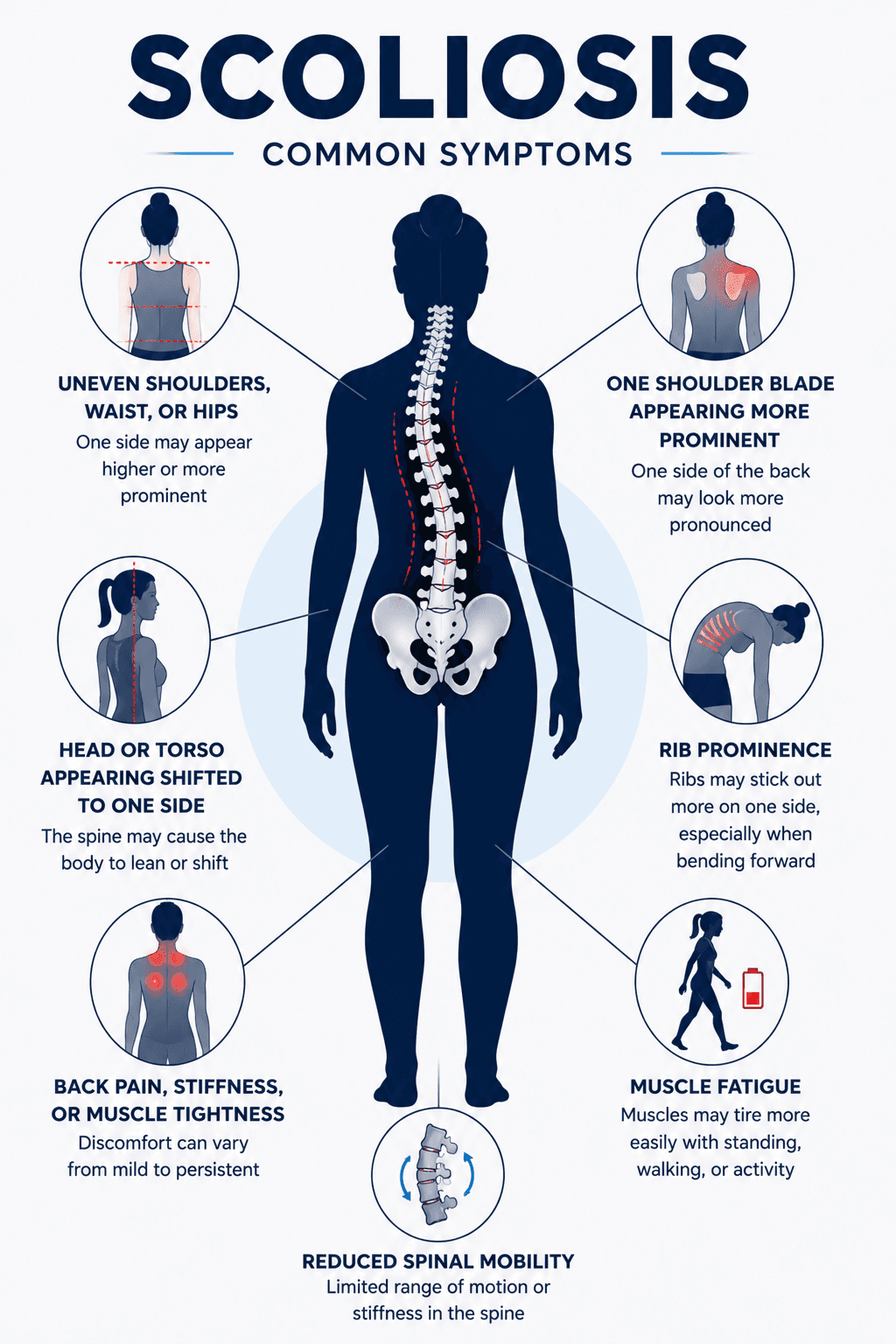
A structural overview of scoliosis, postural asymmetry, and movement-related symptoms.
Common Causes
Common Causes & Contributors
Scoliosis is not always caused by one clear event. In many cases, especially adolescent idiopathic scoliosis, the exact cause is unknown. Other cases may be related to congenital spinal development, neuromuscular conditions, age-related degeneration, injury history, or long-standing movement compensation.
Idiopathic scoliosis, where the cause is unknown
Growth-related spinal changes during adolescence
Congenital scoliosis related to spinal development before birth
Neuromuscular conditions that affect muscle control and spinal support
Degenerative changes in the discs, joints, or surrounding spinal structures
Muscle imbalance around the spine, ribs, pelvis, or hips
Reduced thoracic, lumbar, or hip mobility
Postural compensation patterns and repetitive mechanical stress
Prior injury or long-standing movement asymmetry
When To Seek Care
When to Seek Care
Consider a professional evaluation if:
You notice uneven shoulders, hips, waist, ribs, or shoulder blades
Postural asymmetry appears to be changing or becoming more noticeable
Back pain, stiffness, or muscle fatigue is affecting daily activity
Symptoms are worsening, recurring, or becoming harder to manage
Standing, walking, sitting, breathing, or exercise tolerance feels limited
You have a known scoliosis diagnosis and want support for mobility, strength, and function
You are unsure whether updated imaging, monitoring, referral, or co-management may be appropriate
How Care Helps
How Care May Help
At Back to Balance Chiropractic & Wellness, conservative care for scoliosis focuses on improving how the body moves and functions around the spinal curve. The goal is not to force the spine straight or claim to reverse a structural curve. The goal is to support better mobility, strength, control, comfort, and activity tolerance. Your individualized care plan may include:
The emphasis is on helping the body function better with the curve, reducing unnecessary mechanical stress, and supporting long-term movement quality.
01
Chiropractic adjustments when clinically appropriate to improve joint mobility and reduce mechanical restriction
02
Soft tissue therapy to address muscle tension, guarding, and compensation patterns
03
Corrective exercise and functional rehabilitation focused on spinal support and postural endurance
04
Postural training and ergonomic recommendations for daily movement
05
Movement and structural assessment of posture, spinal mobility, rib mechanics, and hip motion
06
Breathing mechanics and rib mobility work when clinically relevant
07
Home strategies to support mobility and reduce recurring stiffness
08
Referral or co-management when imaging, bracing, orthopedic evaluation, or specialty care is appropriate
Clinical Takeaway
Scoliosis is a structural spinal curve, not just a posture problem. Effective care focuses on function, mobility, strength, and monitoring when needed.
Conservative care does not cure structural scoliosis, but it may help improve how the spine, ribs, hips, and surrounding muscles move and tolerate daily demands.
FAQ
Questions About Scoliosis
Answers to a few of the most common questions patients may have before getting started.
Related Care
Explore connected services and conditions
Learn how related symptoms, movement patterns, and treatment options may fit into a broader care plan.
Related Services


Related Conditions



Ready for scoliosis-focused support?
Schedule a consultation to evaluate spinal mobility, posture, and movement patterns, and discuss conservative options for improving day-to-day function.